A medical implant can complete its intended purpose and still have a story to tell after it is removed.
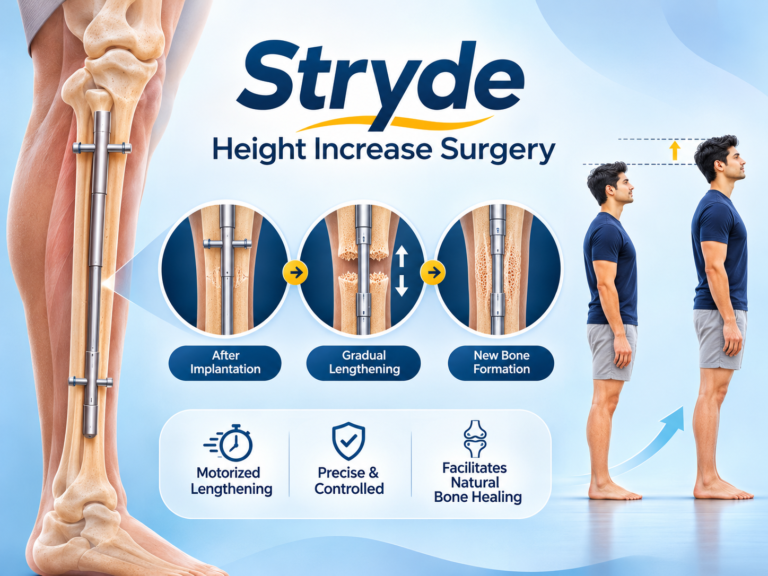
During internal limb lengthening, a specialized nail is placed inside the femur or tibia. It helps maintain alignment while the bone gradually becomes longer. Once treatment is completed and sufficient healing has occurred, the surgeon may recommend removing the device.
But what happens to the implant afterward?
Some removed nails become part of clinical research. By examining their surfaces, moving components, and surrounding tissue findings, researchers can learn how these devices behaved inside the body.
For patients researching internal limb lengthening surgery in India, these studies offer valuable information about implant performance and safety.
Why Researchers Examine Removed Lengthening Nails
Internal lengthening nails are exposed to repeated mechanical forces throughout treatment.
They must withstand bending, maintain stability, and allow controlled extension while the bone regenerates.
Although X-rays can show implant position and bone healing, they cannot reveal every microscopic change occurring on the device.
Retrieval research provides another perspective.
After a nail has been removed, investigators may inspect its surface for wear, corrosion, deformation, or changes around moving components.
These findings can help researchers understand whether a device performed as expected and whether certain design features deserve closer investigation.
What Can a Removed Implant Reveal?
A retrieved nail may provide information that was not visible during routine clinical follow-up.
Researchers can examine the junction between telescoping components, locking screw holes, and areas exposed to repeated movement.
Specialized microscopy can identify surface damage, while material analysis can help determine the composition of deposits or debris.
Such investigations are particularly useful when patients experienced unexplained discomfort or imaging showed unusual bone changes.
However, finding wear or corrosion does not automatically establish that every patient with the same device will experience complications.
The clinical significance depends on the implant, the findings, and the patient’s medical history.
What Precice Stryde Retrieval Studies Found
Precice Stryde was developed as a stainless-steel internal magnetic nail intended to provide greater mechanical strength during limb lengthening.
Later research identified concerns that were not fully apparent from its original mechanical design.
A published analysis examined 23 retrieved Stryde implants. Researchers found visible corrosion-related discoloration around the telescoping junction in 20 of the 23 nails.
Detailed imaging also identified corrosion in all 12 bushings selected for micro-CT examination.
These observations raised concerns about how certain components behaved under mechanical loading while exposed to the body’s internal environment.
The research demonstrated why examining the implant after removal can provide information beyond whether the planned lengthening was achieved.
Mechanical Wear and Biological Reactions Are Different Questions
An important lesson from retrieval research is that mechanical performance and biological compatibility are not identical.
A nail may remain mechanically functional while developing changes on its surface.
Likewise, an unusual bone reaction does not automatically mean the lengthening mechanism has failed.
Researchers therefore consider different outcomes separately.
They may examine whether the device extended accurately, whether the bone consolidated, whether corrosion occurred, and whether the patient experienced pain or abnormal bone findings.
Understanding these distinctions helps patients avoid interpreting one laboratory observation as proof of a particular clinical outcome.
Why Device Design Matters Alongside Material
It may be tempting to assume that every stainless-steel implant behaves in the same way.
That would be misleading.
Implant performance depends not only on the metal used but also on component design, manufacturing, surface treatment, movement, and the environment inside the body.
The Stryde retrieval research found that corrosion was associated with areas such as telescoping junctions and locking components.
These observations suggest that the interaction between mechanical design and material behaviour deserves careful investigation.
For patients exploring historical Stryde technology, Height Increase Info provides educational information about the device, its design, safety considerations, and follow-up requirements in India.
What Research Reveals About Nail Removal
Retrieval research is not limited to inspecting the implant itself.
Researchers also study complications associated with removing internal lengthening nails.
One retrospective study examined 271 elective nail removals involving Fitbone, Precice, and Stryde devices.
Complications were reported during approximately 3% of removal procedures and after 13% of procedures.
Reported problems included postoperative knee pain and fractures following removal.
These findings matter because implant removal is a separate surgical event with its own risks.
A successful original lengthening procedure does not automatically guarantee that removal will be completely straightforward.
Why These Results Should Be Interpreted Carefully
Retrieval studies have important limitations.
Researchers usually examine implants that have already been removed, rather than every device implanted in all patients.
Some implants may have been removed routinely after completing treatment. Others may have been removed because of symptoms or suspected complications.
This can affect which devices appear in a study.
The number of examined implants may also be relatively small.
For example, a finding observed in 20 out of 23 retrieved nails should not automatically be interpreted as the complication rate among every patient who received that implant.
These studies provide important evidence, but their conclusions must remain connected to the patients and devices actually examined.
What Does the Research Mean for Patients With Stryde Nails?
Precice Stryde has a significant regulatory history.
The FDA’s June 2023 safety communication states that stainless-steel Precice devices, including Stryde, remain recalled from the United States market because of potential biocompatibility concerns and should not be implanted there.
That U.S. regulatory status does not independently establish whether the device is authorized or available in India.
Patients who already have a Stryde nail should discuss device-specific monitoring with their orthopedic surgeon.
New pain, swelling, or reduced function should be evaluated.
Importantly, patients should not make independent decisions about implant removal based only on retrieval studies or recall headlines.
Questions Worth Asking During Follow-Up
Patients with an existing internal lengthening nail may benefit from asking their doctor several practical questions.
Which exact implant model was used?
Does it have any relevant safety notices?
Are follow-up X-rays recommended?
Has the bone fully consolidated?
Is implant removal advised?
What risks are associated with removal?
These questions help connect published research with the patient’s actual medical situation.
Final Thoughts
Published internal nail retrieval research gives orthopedic specialists information that cannot always be obtained while the implant remains inside the body.
Researchers can examine wear, corrosion, moving components, material changes, and complications associated with removal.
Studies involving Precice Stryde have highlighted why long-term implant assessment is important, even when the device successfully completes its lengthening function.
For patients, the main lesson is not to fear every internal implant or assume all devices share the same risks.
It is to understand that successful bone lengthening, implant performance, biological safety, and removal outcomes are separate parts of treatment.
Reviewing clinical evidence alongside advice from an experienced orthopedic surgeon can help patients make informed decisions about internal limb lengthening and long-term follow-up.