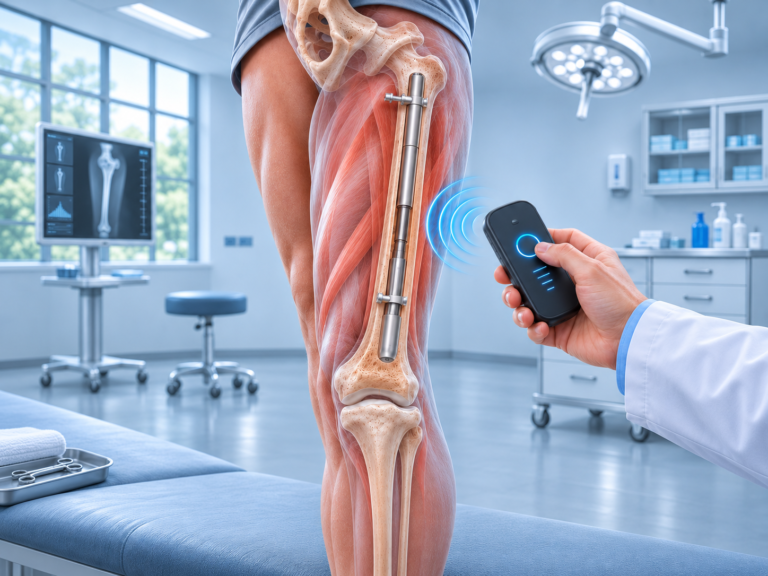
One question often comes up when patients approach the final stages of limb lengthening treatment: “If my bone has healed, why is the metal nail still inside?”
It is a reasonable question. After months of surgery, gradual lengthening, medical appointments, and physiotherapy, patients naturally want to know when the entire process will be complete.
However, bone healing and implant removal are two different medical decisions. The bone may reach sufficient strength for certain activities before the surgeon decides that removing the internal nail is appropriate.
Understanding this difference helps patients prepare for the complete treatment journey rather than assuming the implant will be removed immediately after the desired height is achieved.
Bone Lengthening Has More Than One Finish Line
Internal limb lengthening involves several stages.
First, a surgeon performs a controlled bone cut and places an internal lengthening nail. During the distraction phase, the nail gradually extends, creating space where the body produces new bone.
After the planned length is reached, distraction stops.
But the newly formed bone is still developing. It must become denser and stronger through consolidation.
Even when consolidation has progressed well, the patient may continue rehabilitation to restore muscle strength, joint flexibility, and walking ability.
Implant removal is a separate decision made after reviewing healing, device-specific guidance, and individual medical circumstances.
Why Bone Consolidation Matters First
The new bone created during lengthening is initially less mature than the surrounding original bone.
During consolidation, this tissue gradually mineralizes and develops the strength needed for everyday movement.
Doctors use follow-up X-rays and clinical examinations to evaluate progress.
A patient may feel comfortable walking while the surgeon still wants further evidence of bone strength before recommending another operation.
This explains why reaching the planned height, achieving adequate bone consolidation, and scheduling implant removal may happen at different times.
Why the Nail May Remain After Lengthening Stops
The internal nail supports alignment and mechanical stability during treatment.
Once distraction ends, the nail generally remains in place while consolidation continues.
Removing it prematurely may leave the lengthened area without sufficient internal support.
However, keeping an implant indefinitely is not automatically appropriate either.
Different devices have different manufacturer recommendations, indications, and safety considerations. The treating surgeon must balance bone strength, implant condition, and the risks of another surgical procedure.
For patients researching internal lengthening technology, Height Increase Info provides educational information about Precice Stryde, implant-related safety concerns, historical device design, and recovery considerations in India.
Why There Is No Universal Removal Date
A common mistake is assuming that every internal lengthening nail should be removed after the same number of months.
Clinical practice and device instructions vary.
For example, the U.S. FDA’s June 2023 guidance for certain titanium-based Precice devices states that removal should occur after one year.
The Royal National Orthopaedic Hospital’s patient information describes an approximate 18–24-month period with a Precice nail in its treatment pathway.
These references demonstrate why patients should follow the current instructions applicable to their exact implant and their surgeon’s assessment rather than an estimated timeline found online.
The type of implant, bone healing, medical complications, and other individual circumstances may affect the final plan.
What Research Says About Actual Removal Timing
A published study examined 271 elective removals of internal lengthening nails, including Fitbone, Precice, and Stryde devices.
The average period between nail insertion and removal was approximately 536 days, but individual cases varied considerably.
This variation reflects how removal timing depends on clinical circumstances and treatment planning rather than one standard calendar date.
The study also reported complications during 3% of removals and after 13% of removals.
These findings highlight another important point: removing a lengthening nail is a separate surgical procedure with its own risks.
Does Normal Walking Mean the Nail Can Be Removed?
Not necessarily.
A patient may regain independent walking before implant removal is planned.
Walking ability depends on bone strength, muscle control, joint movement, balance, and rehabilitation progress.
Implant removal requires an additional assessment of whether the bone can safely tolerate the procedure and subsequent recovery.
Being able to walk comfortably is encouraging, but it should not be treated as sufficient evidence that the implant is ready to come out.
Why Precice Stryde Requires Special Attention
Precice Stryde has a distinct safety history.
Its stainless-steel construction was originally designed to provide increased mechanical support during internal limb lengthening.
However, the device was recalled from the United States market following concerns about potential biocompatibility problems.
The FDA’s June 2023 communication states that stainless-steel Precice devices, including Stryde, remain recalled in the United States and should not be implanted there.
Patients who already have a Stryde nail should discuss monitoring and removal individually with their orthopedic surgeon. The recall does not mean every functioning implant must automatically be removed without evaluating the patient’s circumstances.
The U.S. recall also does not independently establish current Indian regulatory status.
What Happens After Implant Removal?
Removal surgery does not necessarily mark the end of all recovery precautions.
The surgeon may advise temporary activity restrictions while the surgical sites heal.
Previous screw positions and other areas affected by removal may require additional protection.
Some patients may need walking support or physiotherapy depending on the procedure and their medical condition.
Follow-up remains important because complications can occasionally occur after nail extraction.
Patients should ask when they can safely resume work, travel, exercise, and more demanding physical activities.
Questions Worth Asking Before Removal
Before implant removal, patients should discuss the exact device model, recommended removal period, latest X-ray findings, expected surgical approach, potential complications, and postoperative restrictions.
They should also ask whether the operation is included in the original treatment package or charged separately.
Understanding these details early can make medical and financial planning more manageable.
Final Thoughts
Bone healing and implant removal follow different timelines because they serve different purposes.
Consolidation strengthens the newly generated bone. Rehabilitation restores movement and function. Implant removal is a separate surgical decision based on the patient’s healing progress and the device’s specific requirements.
For patients undergoing internal limb lengthening surgery in India, the important goal is not to remove the nail as quickly as possible.
It is to ensure that the implant is managed according to current safety guidance and that any removal procedure is performed at an appropriate time.
The height goal may be achieved first, but the complete treatment journey continues until bone healing, implant management, and functional recovery have been properly addressed.