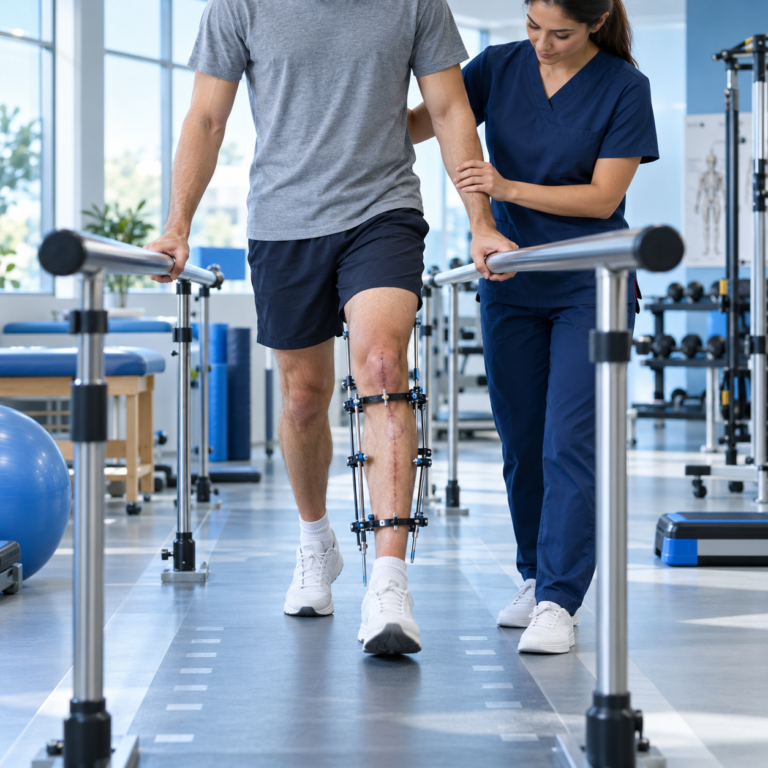
Walking may look automatic, but every step depends on a coordinated sequence of movements through the hip, knee, ankle, muscles, and nervous system.
After limb lengthening surgery, that familiar pattern can change.
The bone has gradually become longer. Muscles have adapted to a different resting length. Weight bearing may have been limited for weeks or months. Crutches or a walker may have changed how the patient distributes body weight. Even after the bone begins healing well, the body may still be using temporary movement habits developed during recovery.
This is why walking after limb lengthening is not always something that simply “returns” on its own.
In many cases, it has to be retrained.
Why the Walking Pattern Changes
During the lengthening phase, patients usually do not walk in exactly the same way they did before surgery.
They may be using crutches. One or both legs may accept less weight. Steps may become shorter. The body may lean slightly to one side for stability.
These changes are often practical adaptations to the treatment stage.
However, if they continue for long enough, they can become learned movement patterns.
Hospital for Special Surgery notes that patients remain mobile during limb lengthening but commonly use crutches, while physiotherapy is used throughout recovery to preserve muscle strength and joint flexibility.
As healing advances, simply removing the walking aid does not automatically restore the previous gait.
The body needs to learn how to use the new limb length efficiently.
The Hip Controls More Than Forward Movement
The hip plays an important role in keeping the pelvis level while walking.
If hip muscles become weak during recovery, the pelvis may drop or the patient may shift the upper body to compensate. This can create an uneven walking pattern even when both legs are structurally aligned.
Hip strength also influences step control and balance.
Rehabilitation therefore often includes exercises for the gluteal and surrounding hip muscles rather than focusing only on the surgical bone.
The rehabilitation program published by Height Increase Info progresses from basic leg activation toward strengthening and later muscle-balance restoration as recovery develops.
Knee Control Affects Every Step
The knee must bend and straighten smoothly during walking.
During limb lengthening recovery, muscle tightness can reduce full knee extension. Weak quadriceps may also make it harder to control the leg as weight transfers onto it.
The Height Increase Info rehabilitation guidance identifies flexion deformities and muscle tightness around the joints as potential recovery challenges.
Even a small limitation in knee movement can change step length and posture.
Gait retraining therefore works alongside flexibility and strengthening rather than treating walking as a separate problem.
Ankle Movement Helps the Foot Meet the Ground Properly
The ankle is especially important after tibial lengthening.
A normal step requires the ankle to move through different positions as the heel touches the ground, body weight moves forward, and the toes prepare to push off.
If the calf becomes tight and ankle flexibility decreases, the patient may compensate by walking on the toes, shortening the step, or changing knee position.
The rehabilitation page specifically identifies equinus deformity—sometimes called ballerina foot—as a risk when calf tightness limits ankle flexibility.
This is why calf stretching and ankle mobility can directly influence walking quality.
For patients researching structured recovery support, Height Increase Info provides information about limb lengthening physiotherapy, mobility training, strength recovery, and walking rehabilitation in India.
Weight Distribution Has to Become Even Again
Another important part of gait recovery is learning to trust the operated limb.
When patients spend weeks protecting one side or limiting weight bearing, they may automatically shift more weight onto the stronger leg.
Even after doctors allow more loading, that habit may continue.
A physiotherapist can help the patient practice symmetrical standing, controlled weight transfer, and gradual loading.
The objective is not to force equal weight immediately.
It is to rebuild confidence while the bone and muscles become ready for greater demand.
HSS describes gradual weight-bearing progression as healing advances, which helps explain why gait recovery usually develops in stages rather than all at once.
Step Length May Need to Be Relearned
Limb lengthening changes the dimensions of the leg.
That means the movement that once produced a comfortable step may no longer feel exactly the same.
Patients may initially take shorter steps because of stiffness, weakness, fear, or reduced balance.
Gait training can gradually work on step length, rhythm, foot placement, and coordination.
This does not mean trying to force a “perfect” walking pattern immediately.
The goal is controlled improvement as flexibility and strength return.
Balance and Coordination Matter as Much as Strength
Walking requires the body to repeatedly balance on one leg for brief moments.
After a long period of assisted mobility, this ability may feel less automatic.
Balance exercises help retrain the nervous system and muscles to respond together.
The final recovery phase described by Height Increase Info includes improving balance and coordination alongside rebuilding muscle strength and restoring full mobility.
This is one reason patients may still benefit from supervised physiotherapy even after they can walk without crutches.
Walking independently and walking efficiently are not always the same milestone.
Gait Retraining Is Usually Gradual
A patient’s walking pattern should not be judged only by how quickly they can move without support.
Therapists may look at:
- step length,
- pelvic position,
- knee extension,
- ankle movement,
- weight distribution,
- balance,
- muscle control,
- and overall confidence.
Improvement may happen slowly.
One week, the main achievement may be standing evenly.
Later, it may be taking longer steps.
After that, the focus may shift toward stairs, endurance, or walking on uneven surfaces.
This staged approach matches the broader rehabilitation model, where exercises evolve as bone consolidation, strength, and mobility improve.
Final Thoughts
Walking after limb lengthening surgery is not just about whether the bone has healed.
The entire movement system has changed during treatment.
Muscles may be weaker.
Joints may be tighter.
Balance may be reduced.
Weight-bearing habits may have shifted.
And the patient may need time to trust the newly lengthened limb again.
That is why walking mechanics often require retraining.
The goal of rehabilitation is not simply to help the patient take steps without support.
It is to rebuild a walking pattern that is balanced, controlled, efficient, and comfortable at the new limb length.