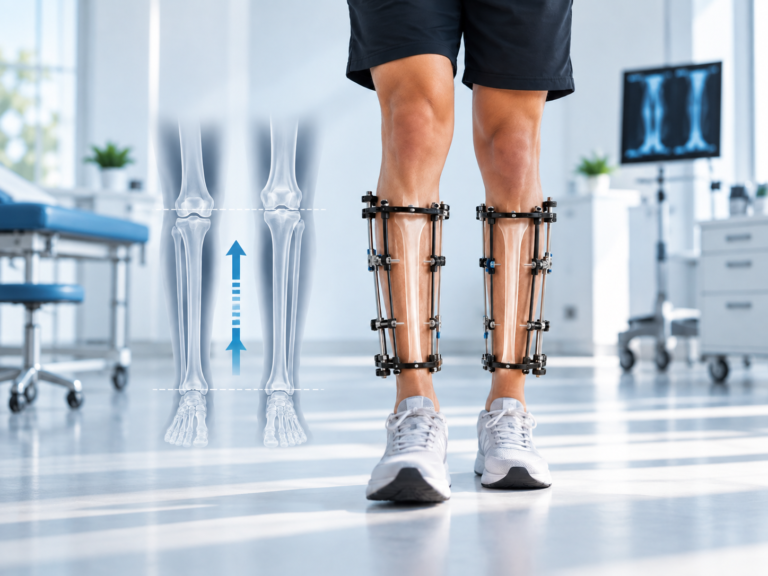
Tibia height increase surgery is a specialized orthopedic procedure in which the shin bones are gradually lengthened to increase overall leg length. The tibia runs from the knee to the ankle and makes up an important part of a person’s lower-leg height. Patients researching tibia height increase surgery in Gurgaon often want to know what actually happens during treatment, how the bone becomes longer, and what recovery requires.
The process is very different from an instant height change. Limb lengthening happens slowly, giving the body time to create new bone while the muscles, joints, nerves, and other soft tissues adapt. Because the tibia is closely connected with the ankle and calf muscles, careful rehabilitation is especially important.
How Tibia Height Increase Surgery Begins
Treatment starts with a detailed orthopedic assessment. The doctor may examine the patient’s bone structure, limb alignment, knee and ankle movement, muscle flexibility, medical history, and overall health.
Imaging is also used to plan the procedure and understand the condition of both tibias. The medical team then decides whether tibial lengthening is suitable and which technique may be appropriate.
Patient selection is important because height increase surgery requires more than healthy bones. The patient must also be prepared for regular physiotherapy, follow-up imaging, mobility limitations, and several months of recovery.
What Happens During the Procedure?
During tibia lengthening surgery, a controlled surgical cut known as an osteotomy is made in the tibia. A specialized device is then applied or inserted to allow gradual separation of the bone segments.
The device may be an internal lengthening nail, an external fixator, or a combination of both depending on the chosen method. The bones are not lengthened to their final position during the operation itself.
Instead, the lengthening phase starts gradually after surgery. As the bone segments are slowly moved apart, new bone begins developing in the created gap through a process known as distraction osteogenesis. The treatment page describes gradual distraction at approximately 1 mm per day, with the exact plan requiring medical supervision and adjustment according to the patient’s progress.
Methods Used for Tibia Lengthening
Different techniques can be considered for tibia height increase surgery.
An internal lengthening nail is placed completely inside the bone and allows controlled lengthening without a large external frame.
The LON technique, or Lengthening Over Nail, combines an intramedullary nail with temporary external fixation. The external frame is used during lengthening and may later be removed while internal support maintains stability.
External fixation methods, such as circular Ilizarov frames, may also be considered in selected situations, especially when more complex correction is required.
For patients researching these treatment options, Height Increase Info provides information about tibia lengthening methods, procedure planning, rehabilitation, and recovery support in Gurgaon.
What Happens After the Lengthening Phase?
Once the planned length has been achieved, the treatment enters the consolidation phase. During this stage, the newly formed bone needs time to strengthen and mature.
Regular X-rays help the orthopedic team check how well the new bone is developing and whether alignment is being maintained. The patient may still require walking aids or restrictions on weight-bearing depending on the surgical method and healing progress.
This phase is important because gaining the required length is only one part of treatment. The new bone must become strong enough to support normal daily movement safely.
Why Ankle Mobility Matters
Tibia lengthening places particular stress on the muscles and structures around the ankle. As the shin bone becomes longer, the calf muscles and soft tissues must also gradually adjust.
If these tissues become too tight, ankle movement may become restricted. This may affect foot position and walking mechanics. The treatment page highlights regular calf stretching and physiotherapy to reduce ankle stiffness and help prevent equinus, sometimes called ballerina foot.
For this reason, ankle flexibility is closely monitored throughout tibial limb lengthening.
Physiotherapy During Recovery
Physiotherapy is a major part of recovery after tibia height increase surgery. Exercises may focus on ankle movement, calf flexibility, knee mobility, muscle strength, balance, and walking mechanics.
During the earlier stages, patients may perform controlled mobility exercises and stretching. As healing progresses, the rehabilitation program may move toward strengthening, supported standing, balance training, and gait practice.
Consistency is important. Missing rehabilitation sessions or ignoring stretching can make stiffness and weakness harder to manage later.
Patients should follow the program recommended by their surgeon and physiotherapist rather than increasing exercises or weight-bearing independently.
How Long Does Recovery Take?
Recovery is different for every patient. The treatment page gives a broad full-recovery range of approximately 7–12 months depending on the amount of correction and individual progress.
The actual timeline can be influenced by bone healing, the method used, soft tissue flexibility, general health, rehabilitation consistency, and the amount of lengthening performed.
Patients should therefore avoid treating another person’s recovery timeline as their own.
Final Thoughts
Tibia height increase surgery in Gurgaon is a structured orthopedic treatment that gradually increases lower-leg length through controlled bone regeneration.
The surgical procedure is only the beginning. Safe progress also depends on regular imaging, ankle and knee mobility, physiotherapy, muscle flexibility, and careful recovery management.
Anyone considering tibia height increase surgery should first undergo a detailed orthopedic evaluation and discuss realistic goals, available techniques, possible risks, rehabilitation requirements, and expected recovery responsibilities.
Understanding the complete journey before surgery helps patients make a more informed decision and prepare properly for both the lengthening process and the months of recovery that follow.