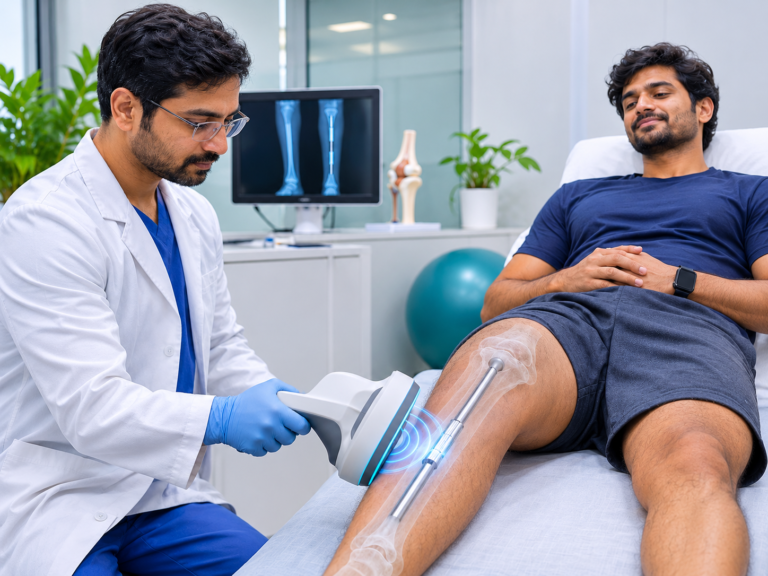
Precice limb lengthening is a fully internal technique in which a telescopic nail is placed inside the femur or tibia and gradually extended using a magnetic remote controller. For patients researching Precice limb lengthening in India, it is important to understand that surgery is only the beginning of the process.
The complete journey includes surgical planning, nail placement, controlled distraction, regular imaging, physiotherapy, protected mobility, and finally bone consolidation.
Each stage has a different purpose, and progress depends on how both the bone and surrounding soft tissues respond.
The Journey Starts Before Surgery
Before a Precice nail is inserted, the orthopedic team evaluates the patient’s anatomy and treatment goals.
Doctors may review:
- bone length and alignment,
- internal bone canal size,
- joint flexibility,
- bone quality,
- medical history,
- and the amount of lengthening being planned.
Internal nail selection requires careful planning because the implant must fit securely within the bone while maintaining enough stability throughout the lengthening period. HSS surgical guidance emphasizes that nail length, nail diameter, osteotomy location, and bone anatomy all influence planning.
This means two patients seeking a similar height increase may still need different implant sizes or treatment plans.
What Happens During Precice Surgery?
During surgery, a controlled osteotomy is performed. This means the surgeon carefully divides the bone at the planned location.
A telescopic Precice nail is then inserted into the marrow canal of the bone and fixed in position.
HSS describes the system as an internal lengthening nail placed inside the bone, with a remote controller that activates a magnetic mechanism inside the rod. The internal gears cause the nail to extend gradually over time.
Because the implant remains inside the limb, there is no large external fixation frame around the leg during distraction.
That can make daily care more convenient, but it does not remove the need for structured recovery.
The Lengthening Phase Begins Gradually
The target height is not created during surgery itself.
After the initial recovery period, distraction begins according to the surgeon’s schedule. The External Remote Controller is placed over the magnetic section of the implant and used to produce small, controlled increases in nail length.
As the two bone segments slowly move apart, new bone begins forming in the space between them.
This biological process is known as distraction osteogenesis.
HSS describes internal limb lengthening as a slow, regular process in which the bone is gradually separated while new bone regenerates within the gap.
For patients researching this treatment, Height Increase Info provides information about Precice nail lengthening, magnetic distraction, patient requirements, weight-bearing restrictions, and rehabilitation in India.
Why Regular X-Rays Matter During Distraction
The magnetic remote controls the nail, but it cannot determine whether the body is responding correctly.
That is where imaging becomes important.
Follow-up X-rays allow the orthopedic team to check:
- how much distraction has occurred,
- whether new bone is forming,
- whether alignment remains stable,
- and whether the nail is maintaining the planned position.
If regenerate bone appears slower or faster than expected, the treatment plan may need adjustment.
This is one reason Precice treatment should never be viewed as an automatic process. The implant may be technologically advanced, but clinical monitoring still guides the pace.
Physiotherapy Happens at the Same Time
While the bone is becoming longer, muscles and joints are also being asked to adapt.
That can create tightness around the hip, knee, ankle, or calf depending on which bone is being lengthened.
Physiotherapy therefore runs alongside the distraction phase.
Exercises may focus on:
- maintaining joint range of motion,
- stretching tight muscles,
- preserving strength,
- improving circulation,
- and preventing compensatory movement patterns.
HSS provides dedicated physical therapy guidance for both femoral and tibial Precice lengthening, showing how closely rehabilitation is integrated into internal nail treatment.
A successful lengthening is not simply one that creates extra centimetres. The patient also needs to maintain useful movement.
Weight Bearing Remains Controlled
Because the Precice nail is internal, patients may assume they can walk normally much sooner.
That is not necessarily true.
The nail provides mechanical support, but the new bone forming in the distraction gap is still immature. Weight-bearing limits depend on factors such as nail diameter, bone quality, treatment stage, and the surgeon’s instructions.
Patients may therefore continue using crutches or another walking aid during part of the lengthening journey.
The absence of an external frame changes convenience.
It does not eliminate recovery restrictions.
What Happens When the Target Length Is Reached?
Once the planned length has been achieved, use of the remote controller stops.
This marks the end of distraction—but not the end of treatment.
The patient now enters the consolidation phase.
During consolidation, the regenerate bone gradually becomes denser and stronger. No additional length is being created, but biological healing continues.
The internal nail stays in place to support alignment and stability while this process develops.
Progress during this stage is judged through repeat X-rays and clinical assessment rather than through additional centimetres.
Activity Increases as the Bone Strengthens
As consolidation progresses, the orthopedic team may gradually allow more loading through the limb.
Walking aids can be reduced according to healing, muscle strength, balance, and imaging findings.
This stage may feel slower because the visible height increase has already happened.
But consolidation is what turns newly generated tissue into stronger functional bone.
Patients also continue physiotherapy to restore muscle balance, walking mechanics, endurance, and confidence.
Recovery therefore becomes less about creating length and more about learning to use the final length effectively.
Final Thoughts
Precice limb lengthening in India is a staged orthopedic process rather than a single surgical event.
The journey begins with planning and nail insertion.
It continues through magnetic distraction and new bone formation.
Regular X-rays monitor progress.
Physiotherapy helps muscles and joints adapt.
And once the target length is reached, consolidation begins so the new bone can become strong enough for normal function.
The technology inside the nail may control the mechanical lengthening, but successful recovery still depends on careful medical supervision, rehabilitation, patience, and gradual progression.
The operation creates the opportunity for additional length.
Consolidation is what helps turn that length into a stable, usable limb.