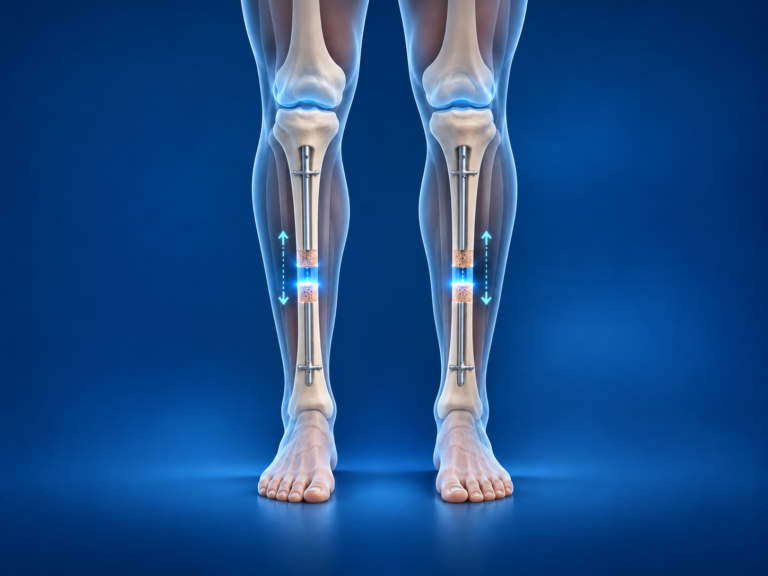
The first few weeks after a fracture can bring encouraging changes. Swelling decreases, pain becomes more manageable, and follow-up X-rays begin showing signs of new bone formation.
However, a later appointment may reveal that healing has slowed considerably or stopped progressing.
For patients who believed their recovery was moving in the right direction, this can be confusing. How can a bone begin repairing itself but fail to complete the process?
Fracture healing depends on several biological and mechanical conditions working together. When these conditions become unfavorable, even a promising recovery can develop into delayed union or nonunion.
Early Bone Formation Does Not Confirm Complete Healing
During fracture repair, the body produces new tissue around and between the injured bone fragments.
In many fractures, this tissue gradually develops into callus, which becomes mineralized as healing continues.
The appearance of callus on an early X-ray can indicate that the repair process is active. However, its presence does not necessarily mean that the fragments have established a strong connection.
The developing tissue must continue maturing until sufficient bone bridges the fracture.
If this progression becomes interrupted, visible callus may remain without providing adequate structural strength.
When Mechanical Conditions Change During Recovery
A fracture that was initially well stabilized may experience changes in its mechanical environment over time.
If healing remains incomplete, repeated loading can place continued stress on the fixation system. In some circumstances, screws may loosen, implants may become damaged, or bone fragments may gradually lose their alignment.
These changes can increase movement at the fracture site.
Excessive movement may interfere with the maturation of developing bone tissue, preventing the fracture from establishing a reliable connection.
This is one reason orthopedic surgeons continue monitoring implant stability even after early healing appears satisfactory.
Why New Bone May Form Without Bridging the Fracture
Sometimes an X-ray reveals considerable bone formation around the fracture, yet the central break remains visible.
This pattern can occur in hypertrophic nonunion, where the body demonstrates biological healing activity but mechanical conditions are insufficient for successful union.
The problem is not necessarily an inability to produce new bone. Instead, the developing tissue may lack the stability required to create a continuous structural bridge.
Treatment in such cases may focus on improving fixation rather than relying exclusively on additional bone grafting.
An Infection May Become Apparent Later
Fracture-related infection does not always produce obvious symptoms immediately after an injury or operation.
In some cases, bacteria may persist around the injured bone or fixation implants without causing noticeable fever or wound drainage.
An underlying infection can interfere with bone regeneration and damage surrounding tissues.
Consequently, a fracture that initially appeared to be healing may later demonstrate limited progress.
When infection is suspected, doctors may recommend blood investigations and further diagnostic assessment. Deep tissue sampling during revision surgery may also be necessary.
Normal blood test results alone cannot always exclude a low-grade infection.
Changes in the Biological Healing Environment
Bone repair requires adequate circulation, nutrients, and functioning bone-forming cells.
A severe fracture may damage local blood vessels and surrounding muscles. Although healing can begin, extensive tissue damage may limit the continued development of new bone.
Other factors, including diabetes, nicotine exposure, nutritional deficiencies, and certain medical conditions, can influence the healing response.
Doctors investigating interrupted fracture healing therefore examine the patient’s overall health alongside the condition of the injured bone.
For individuals researching fracture not healing treatment in India, Height Increase Info provides educational information about nonunion assessment, revision surgery, bone grafting, and fracture rehabilitation.
How Doctors Recognize a Healing Plateau
A healing plateau occurs when previously observed improvements are no longer progressing as expected.
Orthopedic specialists assess this by comparing X-rays taken at different stages of recovery.
They examine whether the fracture line is becoming less distinct, whether new bone is bridging the fragments, and whether fixation remains stable.
A CT scan may be recommended when ordinary X-rays cannot clearly establish the extent of bone union.
Clinical findings are equally important. Persistent tenderness, discomfort during permitted weight bearing, and unexpected functional limitations may provide additional information.
The diagnosis should reflect the overall pattern of recovery rather than a single imaging result.
Delayed Union and Nonunion Are Not the Same
A fracture that takes longer than expected to heal may be described as a delayed union.
Although progress is slow, the bone may still demonstrate ongoing repair activity.
Nonunion refers to a fracture that has failed to establish adequate healing and is unlikely to unite without further intervention.
Distinguishing between these conditions matters because their treatment requirements may differ.
Some delayed fractures need additional monitoring and protection, while established nonunions may require more extensive treatment.
There is no single recovery deadline suitable for every fracture.
How Treatment Can Address Interrupted Healing
Once the underlying cause has been identified, the orthopedic team can develop an appropriate treatment plan.
Selected stable fractures may benefit from continued protection or prescribed bone stimulation.
When mechanical instability is responsible, revision fixation may be necessary to improve support.
If the fracture lacks adequate biological activity, bone grafting or other reconstructive techniques may be considered.
Infection-related nonunion requires specific infection management alongside strategies to restore bone healing.
The treatment approach depends on the fracture location, previous operations, bone quality, and surrounding tissue condition.
Why Patients Should Not Rely on Pain Improvement Alone
Reduced pain is encouraging, but it does not confirm that a fracture has united.
An internal fixation device may continue supporting an incompletely healed bone, allowing symptoms to remain relatively manageable.
Patients should attend scheduled follow-up appointments and avoid independently increasing weight bearing or changing rehabilitation exercises.
New or worsening pain, redness, swelling, fever, or wound drainage should be reported promptly.
Final Thoughts
A fracture can show early signs of repair without completing the healing process.
Mechanical instability, infection, compromised circulation, and underlying health conditions may interrupt further bone formation.
Effective nonunion fracture treatment begins with understanding why recovery has stalled rather than assuming that additional time will solve the problem.
Regular imaging, clinical assessment, and individualized treatment help orthopedic specialists determine the appropriate next step.
Early progress is encouraging, but confirmed bone union and functional recovery remain the more meaningful goals of fracture treatment.