Search advertising is no longer just about keywords, bids, and manual optimizations. In recent years, Google has steadily infused artificial intelligence into every layer of its advertising ecosystem. Today, AI-driven ads on Google Search are changing not only how campaigns are managed-but how visibility itself is earned.
This shift marks a fundamental change in how advertisers interact with search.
From Manual Control to Machine-Led Decisions
Traditionally, Google Search ads were built on precision. Advertisers selected keywords, wrote ads, adjusted bids, and monitored performance closely. Success depended heavily on human decision-making.
AI has altered that balance.
Modern Google Search campaigns now rely on machine learning to:
- Predict user intent in real time
- Automatically adjust bids based on likelihood to convert
- Match ads to broader and more complex search queries
- Test multiple ad variations simultaneously
Instead of reacting to data, advertisers increasingly guide systems that learn on their behalf.
Intent Over Keywords
One of the most important changes AI brings to Google Search ads is the move away from strict keyword matching.
AI systems now prioritize search intent over exact phrasing. A single campaign can appear for hundreds of variations a human might never target manually. This includes:
- Long, conversational queries
- Implied commercial intent
- Context-based searches influenced by location, device, or behavior
In practice, this means advertisers are no longer bidding on words alone-they’re bidding on outcomes.
Smarter Bidding in Real Time
AI-powered bidding strategies, such as conversion-focused automation, continuously analyze signals that humans cannot process at scale. These signals include:
- Time of day
- Device type
- Search history
- Location patterns
- Likelihood of conversion
Instead of setting fixed bids, advertisers allow AI to decide when and how much to bid for each auction. This turns bidding into a dynamic system rather than a static rule set.
The result is greater efficiency-but also reduced transparency.
Ads That Write Themselves
AI has also reshaped ad creation. Responsive search ads use machine learning to assemble headlines and descriptions dynamically, testing combinations to determine what performs best.
Over time, the system learns:
- Which messaging resonates with which audience
- Which tone drives clicks or conversions
- Which variations underperform and should be retired
This allows campaigns to evolve continuously instead of being rewritten manually every few weeks.
However, it also means advertisers must focus more on inputs-clear messaging, strong value propositions, and accurate signals-rather than micromanaging outputs.
Performance Max and the Blurred Lines of Search
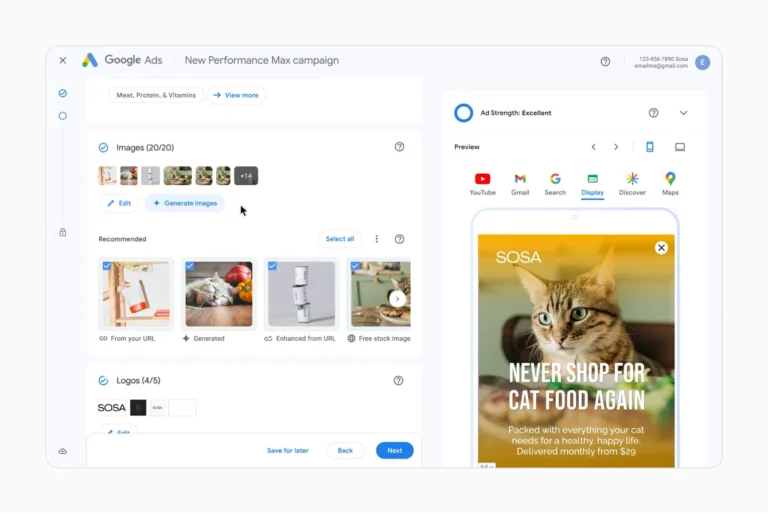
AI-driven formats like Performance Max further blur the distinction between traditional Search ads and other Google placements. Search is no longer isolated-it’s part of a broader AI-managed ecosystem.
While this increases reach and automation, it also reduces granular control. Advertisers trade precision for scale, trusting the system to find opportunities humans might miss.
This makes strategy more important than tactics.
The New Role of the Advertiser
AI does not eliminate the need for expertise-it changes it.
Advertisers now focus on:
- Defining clear conversion goals
- Feeding high-quality data into campaigns
- Structuring accounts logically
- Monitoring performance trends rather than individual keywords
Success depends less on constant adjustments and more on strategic alignment with how AI systems learn.
Risks and Realities
While AI ads offer efficiency, they are not without challenges:
- Less visibility into exact keyword triggers
- Dependency on accurate tracking and conversion data
- Learning periods that require patience
- Difficulty diagnosing performance drops
AI amplifies whatever data it receives. Poor inputs lead to poor outcomes-at scale.
The Future of Google Search Advertising
AI-powered ads signal a broader shift in digital advertising. Search is becoming predictive rather than reactive. Ads appear not just when users search-but when they are most likely to act.
For businesses, this means adapting to a system where control is shared with machines. Those who cling to manual-era tactics risk falling behind. Those who learn to collaborate with AI gain a competitive edge.
Conclusion
AI ads on Google Search are not just an upgrade-they are a new operating model.
They reward clarity, patience, and strategic thinking over constant optimization. They shift focus from keywords to intent, from control to collaboration.
In the evolving search landscape, the question is no longer how much control advertisers have-but how well they guide the intelligence working on their behalf.