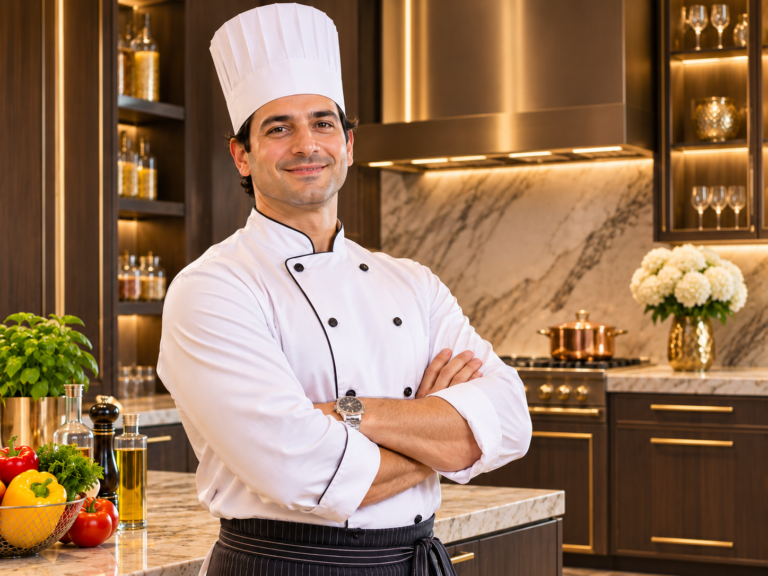
A beautifully designed kitchen does not always have unlimited storage.
In some Doha apartments, penthouses, and modern residences, kitchen appliances are selected to complement the interior design. The refrigerator may be spacious, but the freezer compartment can be surprisingly small.
For a family that enjoys freshly prepared meals every day, this creates an interesting challenge.
Where should the chef store seafood, meat, prepared ingredients, and frozen essentials when there is barely enough room?
An experienced private chef does not necessarily solve this problem by purchasing another freezer.
Instead, the chef can rethink how ingredients are purchased, menus are planned, and food is stored.
With thoughtful organization, even a compact freezer can support a well-managed household kitchen.
1. Start by Understanding the Available Storage
Before changing the household’s grocery routine, a private chef should examine the existing freezer.
The first step is to identify its usable capacity, temperature performance, and current contents.
A freezer may appear full because of oversized packaging, forgotten purchases, or ingredients that are no longer suitable for use.
The chef can review stored products, check their dates and condition, and identify which items should be retained or safely discarded.
However, simply rearranging the contents is not enough.
Adequate space must remain for air circulation, and the freezer should operate at an appropriate temperature.
For frozen storage, a commonly recommended target is -18°C or colder.
The goal is to create an organized system that remains safe and practical.
2. Buy Fresh Ingredients More Frequently
A small freezer changes how a chef approaches grocery shopping.
Instead of purchasing large quantities of frozen ingredients, the chef may arrange smaller, more frequent deliveries.
For example, fresh vegetables, seafood, and meat can be ordered according to the confirmed meal schedule.
This reduces the need to store unnecessary frozen stock.
In Doha, households may have access to supermarkets, specialty suppliers, and grocery delivery services.
A private chef can establish suitable purchasing arrangements based on ingredient quality, availability, delivery reliability, and the family’s preferences.
However, fresh shopping still requires proper planning.
Perishable food must be transported and stored under suitable temperature conditions, and frequent purchasing should not lead to rushed or unreliable sourcing decisions.
3. Plan Menus Around the Kitchen’s Actual Capacity
A private chef should design menus according to the equipment available.
If a household has limited freezer space, preparing large quantities of frozen meals may not be practical.
Instead, the chef can create a weekly menu that relies on fresh ingredients, suitable pantry products, and carefully planned refrigeration.
For example, a family might enjoy freshly prepared fish one evening, a vegetable-based meal the next day, and a rice dish with suitable proteins later in the week.
The menu should consider the storage life of each ingredient.
More perishable products can be scheduled earlier, while suitable longer-lasting ingredients can be reserved for later meals.
This allows the family to enjoy variety without requiring extensive frozen storage.
4. Keep a Small Reserve of Essential Ingredients
Limited freezer space does not mean avoiding frozen food entirely.
A carefully selected reserve can still be useful.
The chef may keep small quantities of regularly used ingredients that are suitable for frozen storage.
However, the reserve should reflect the family’s actual eating habits.
There is little value in storing products that rarely appear on the menu.
A practical inventory should identify what is available, when it was stored, and when it should be used.
The chef can also establish minimum quantities for frequently needed items.
This makes the freezer easier to manage while reducing unnecessary purchases.
5. Avoid Freezing Everything After Cooking
Some households use the freezer as the default destination for leftover food.
When space is limited, this approach quickly becomes impractical.
A private chef can reduce the need for freezing by preparing realistic quantities.
For example, if the family usually eats at home five evenings a week, the chef should not automatically prepare enough food for seven large dinners.
Portions can be adjusted according to the household’s actual attendance and appetite.
Suitable leftovers may be refrigerated and used within safe storage periods, while other food may need to be discarded.
The chef should never keep food beyond appropriate safety limits simply to reduce waste.
Better portion planning is often more useful than creating additional frozen stock.
6. Use Suitable Containers and Clear Labels
Organization matters when freezer capacity is limited.
Large, irregular packaging can occupy more space than necessary.
Where appropriate, a chef may use food-safe, freezer-compatible containers or packaging that protects ingredients and allows efficient storage.
Each item should be clearly identified.
Useful label information may include:
- Ingredient or dish name
- Date frozen
- Quantity or portion count
- Relevant preparation notes
- Allergen information where necessary
Raw and ready-to-eat products should be properly contained and handled to prevent contamination.
The chef should also avoid packing items so tightly that the freezer cannot maintain its operating temperature.
Efficient storage must never come at the expense of food safety.
7. Keep Freezer Inventory Connected to the Weekly Menu
An organized freezer is only useful when the chef knows what is inside it.
A simple inventory can prevent forgotten ingredients and duplicate purchases.
Before ordering groceries, the chef can review existing stock and identify items that should be used first.
For example, if a suitable frozen ingredient is already available, it may be incorporated into an upcoming meal rather than purchasing another supply.
This approach supports better kitchen budgeting and reduces unnecessary storage.
It also helps when household schedules change.
If the family unexpectedly decides to dine outside, the chef can adjust future ingredient orders instead of allowing perishable products to accumulate.
8. Understand Safe Thawing and Refreezing
Proper thawing is especially important when frozen ingredients are used regularly.
Food should not be left on the kitchen counter for extended periods to thaw.
Refrigerator thawing is generally a safer approach because it keeps food under controlled conditions.
Other approved methods may be suitable depending on the product, provided the chef follows the relevant food-safety guidance.
If an ingredient has been thawed, the chef should not automatically return it to the freezer.
Whether refreezing is safe depends on how the food was thawed, handled, and stored.
In Qatar, Ministry of Public Health consumer guidance advises against refreezing thawed food.
Following appropriate food-safety practices protects the household and prevents unnecessary risks.
9. Decide Whether Additional Freezer Capacity Is Necessary
Sometimes a household genuinely needs more frozen storage.
A large family may prefer bulk purchasing, regularly entertain guests, or require a significant quantity of prepared ingredients.
In these circumstances, an additional freezer may be worth considering.
However, the chef should first assess whether improved purchasing and inventory management could solve the problem.
If extra equipment is required, the homeowner should consider available space, electricity supply, ventilation clearance, appliance specifications, and maintenance.
For rented residences, property approval may also be necessary.
The decision should reflect actual household needs rather than assuming that more storage is always better.
10. Choosing a Private Chef With Strong Kitchen Management Skills
Managing limited freezer space requires organization, purchasing discipline, menu flexibility, and food safety awareness.
A chef working in a Doha residence should be comfortable adapting to the property’s existing facilities.
During recruitment, homeowners can ask candidates how they manage grocery frequency, freezer inventory, meal planning, and food storage.
Experience with private household kitchens can be particularly valuable.
For families looking to hire a private chef in Doha, Elite Butlers UAE provides private chef recruitment support for customized menus, grocery sourcing, daily meal preparation, and kitchen management.
Clients can explain their available refrigeration and freezer facilities when discussing suitable chef profiles.
This helps establish practical expectations before the chef begins working in the household.
Conclusion
A kitchen with limited freezer space does not have to limit the quality or variety of home dining.
With careful ingredient purchasing, realistic meal planning, clear inventory records, and appropriate food storage, a private chef can keep the kitchen operating efficiently.
For Doha households, the solution is often not buying more ingredients or installing larger equipment.
It is understanding what the family actually needs and organizing the kitchen accordingly.
A well-managed kitchen is not measured by how much food it can store, but by how effectively its ingredients are used.