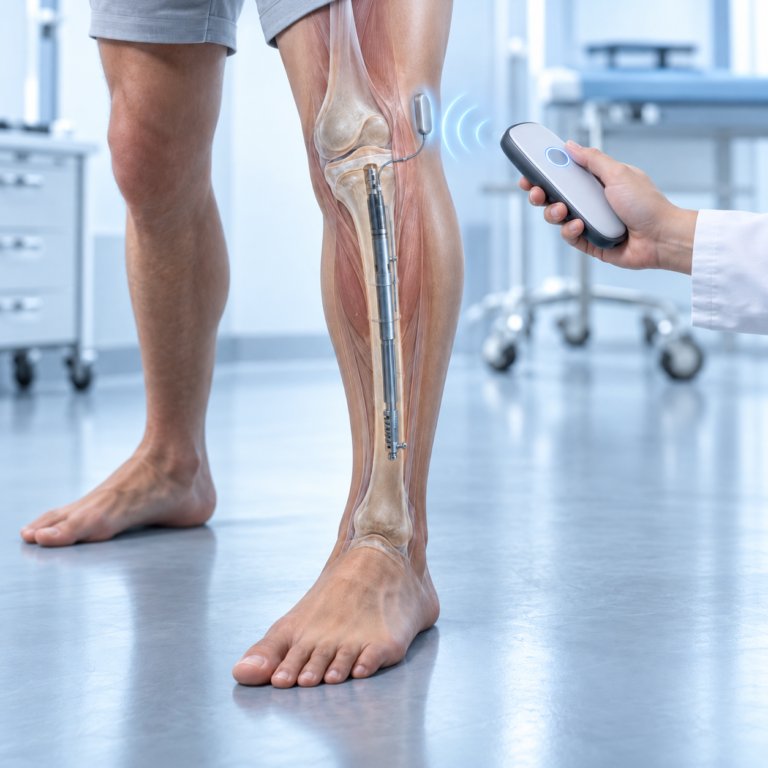
Motorized internal nails have made limb lengthening more precise, but precision does not mean the bone can simply be lengthened as quickly as possible.
In fact, the speed of distraction is one of the most important parts of the entire treatment.
After surgery, the bone is gradually separated so that new bone can form in the space between the two segments. At the same time, muscles, tendons, nerves, blood vessels, and joints must adjust to the increasing limb length.
If this process moves faster or slower than the body can manage, the treatment plan may need to be changed.
That is why motorized nails such as Fitbone are used according to a carefully prescribed distraction rate rather than allowing patients to choose their own pace.
Why Lengthening Happens Gradually
Limb lengthening uses a biological process known as distraction osteogenesis.
After a controlled bone cut, the two bone segments are separated little by little. The body responds by creating new tissue in the gap, which later mineralizes and becomes stronger bone.
Hospital for Special Surgery describes a commonly used lengthening rate of around 1 mm per day, often divided into several smaller adjustments.
The key word is gradual.
The objective is to give the body enough time to create new bone while preventing the gap from closing prematurely.
Faster Does Not Mean Better
Patients may naturally think that increasing the distraction rate could shorten the overall treatment.
But limb lengthening is not a race.
The newly forming bone needs enough biological activity to keep up with the increasing distance between the bone ends. If distraction outpaces bone formation, the regenerate may not develop as intended.
Specialist literature on motorized intramedullary nails emphasizes that accurate control of both the rate and rhythm of distraction is critical for successful limb lengthening. Earlier internal devices that could lengthen unpredictably—too fast or too slowly—were associated with complications.
Modern motorized systems are useful partly because they allow doctors to control this process much more accurately.
Slower Is Not Automatically Safer Either
It is equally important not to assume that slower lengthening is always better.
The treatment team wants the bone segments to separate at a rate that supports continued regenerate formation. An excessively slow process can create a different problem: the developing bone may begin consolidating before the planned length has been achieved.
This is why distraction cannot simply be paused, slowed, or accelerated without medical guidance.
The correct rate depends on how the patient is actually responding.
X-Rays Help Guide the Pace
A motorized nail can produce very precise mechanical movement, but it cannot decide whether the patient’s biology is keeping up.
That is where imaging becomes essential.
Regular X-rays allow the orthopedic team to inspect the regenerate bone developing in the distraction gap. If new bone formation appears slower or faster than expected, the treatment schedule may be adjusted.
Published specialist guidance on internal lengthening notes that distraction rates can be reduced during follow-up based on the radiographic appearance of new bone formation.
For patients researching this process, Height Increase Info explains the Fitbone motorized-nail approach, daily distraction, X-ray monitoring, physiotherapy, and consolidation in Gurgaon.
Bone Is Not the Only Tissue Being Lengthened
A good X-ray is important, but doctors also look beyond the bone.
When a limb becomes longer, the surrounding muscles and other soft tissues are gradually stretched.
The nerves must tolerate that change.
The blood vessels must adapt.
The hip, knee, and ankle must continue moving through useful ranges.
HSS describes limb lengthening as a process in which not only bone but also skin, muscles, nerves, and blood vessels adapt to the slow stretch.
This is one reason a lengthening schedule may need adjustment even when the motorized nail itself is working perfectly.
The limiting factor may be the patient’s biology rather than the device.
Joint Tightness Can Influence the Plan
Suppose the bone is forming well, but the patient begins losing knee or ankle movement.
The medical team cannot simply ignore the joint and continue chasing the original lengthening schedule.
Physiotherapy may need to become more intensive, and in some situations the rate of distraction may need to be reconsidered.
For tibial lengthening, specialists pay particular attention to ankle dorsiflexion and knee extension. During femoral lengthening, knee and hip movement are important rehabilitation priorities.
This demonstrates why the treatment target is more than a number of centimetres.
Maintaining useful movement is part of the result.
Why Several Smaller Sessions May Be Used
Motorized systems allow the planned daily distraction to be divided into smaller increments.
The Gurgaon Fitbone page, for example, describes its current protocol as approximately 1 mm of daily lengthening divided across three sessions.
Dividing the total movement across the day creates a more gradual rhythm rather than asking the tissues to tolerate one larger adjustment.
The exact schedule should always come from the treating surgeon because the appropriate rate can vary according to the bone being lengthened, regenerate quality, joint movement, and individual response.
Patients should never add an extra session simply because they want to reach the height target earlier.
Motorized Precision Still Needs Human Decisions
One of the advantages of a motorized lengthening nail is that it can produce controlled, repeatable movement.
But precision technology does not turn treatment into an automatic process.
The surgeon still needs to decide:
- when distraction should begin,
- how quickly it should progress,
- whether the rhythm should change,
- when lengthening should pause or stop,
- and when the patient should move into consolidation.
Those decisions are based on X-rays, clinical examination, flexibility, pain, nerve symptoms, joint movement, and overall recovery.
The motor performs the movement.
The medical team decides whether that movement remains appropriate.
Final Thoughts
Lengthening speed matters because limb lengthening asks the entire leg to change gradually—not just the bone.
The regenerate needs time to form.
Muscles and tendons need time to stretch.
Nerves and blood vessels need to adapt.
Joints need to maintain movement.
Motorized nails such as Fitbone provide precise control over distraction, but the safest pace is still determined by the patient’s biological response and regular medical monitoring.
The goal is not to reach the target height as quickly as the device can move.
The goal is to reach it at a pace the body can safely follow.